If you view Bitcoin simply as a volatile investment, you are likely missing its true essence. To properly understand Bitcoin, one must first look back at the thousands of years of "monetary history" that humanity has built.
From seashells to Bitcoin, we trace the evolution of money and the journey of trust.
1. The Essence of Money is 'Trust'
While the form of money has changed throughout the ages, its core has always been a 'social agreement to store and exchange value'—in other words, trust.
- The Era of Commodity Money: To solve the inconveniences of bartering, items that everyone valued—such as seashells, salt, and rice—served as money.
- Metallic Money and the Gold Standard: Gold and silver, which are scarce and durable, became the primary currencies. Later, banks began issuing "receipts" for stored gold. This was the origin of paper money, based on the promise that a piece of paper held the same value as gold (The Gold Standard).
- The Era of Fiat Money: The paper money we use today is no longer linked to gold. It circulates solely based on the "credit" guaranteed by the state. This structure allows governments to print an unlimited amount of money whenever they deem it necessary.
2. Why is Bitcoin Called 'Digital Gold'?
Bitcoin is the first digital currency to operate without a central controlling authority. From a historical perspective, Bitcoin possesses the following unique characteristics:
- Mathematical Scarcity: Just as gold has a limited supply in the earth, Bitcoin’s total supply is hard-coded at 21 million units. This prevents governments from arbitrarily increasing the supply and devaluing the asset.
- Decentralization and Blockchain: It enables peer-to-peer transactions without intermediaries like banks. All transactions are recorded on a public ledger called the 'Blockchain,' which is monitored by countless participants simultaneously, making manipulation impossible.
- Immutable Trust: Bitcoin does not rely on human whims or shifting policies. Instead, its foundation of trust is built upon unchanging mathematical algorithms.
3. Why the Younger Generation Must Study Money and Bitcoin
This knowledge is not just about "getting rich"; it is an essential life skill for navigating the future of society.
- Financial Literacy: By understanding why currencies rise and fall, one can grasp the broader flow of the global economy.
- Understanding Technological Innovation: The blockchain technology powering Bitcoin is a core innovation that will reshape not just finance, but security, voting, and logistics.
- Critical Judgment of Value: It fosters the ability to think critically and judge for oneself what constitutes a truly valuable asset.
Conclusion: Forms Change, but the Laws of Trust Remain
In the past, seashells or gold became money because people believed they were valuable. Today, the object of that trust is shifting from paper to data and algorithms.
Therefore, studying Bitcoin is a process of exploring how the tools of trust created by humanity are evolving. I hope that the younger generation—the protagonists of the future economy—will use the history of money as a guide to proactively embrace the era of digital finance.
[Book Recommendation]
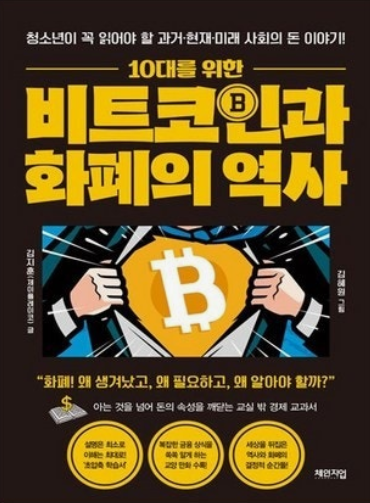
I would like to introduce a book: "Bitcoin and the History of Money for Teens" (10대를 위한 비트코인과 화폐의 역사).
Although it is written for teenagers, I found it incredibly helpful as an adult to easily grasp the core concepts of Bitcoin.
Let's study first. Then, judge for yourself whether it holds value as an asset or not.
'Investing & Finance' 카테고리의 다른 글
| The AI Era’s Golden Triangle: Stocks, Bitcoin, and the New Laws of Wealth (0) | 2026.04.14 |
|---|---|
| AI 시대의 삼각편대: 주식, 비트코인, 그리고 새로운 부의 법칙 (0) | 2026.04.14 |
| 화폐의 역사로 읽는 비트코인: 돈의 미래를 이해하는 법 (0) | 2026.04.13 |
| 비트코인, 정말 신뢰할 수 있는 자산인가? 숫자가 증명하는 3가지 진실 (2) | 2026.04.13 |
| 초보를 위한 아파트 갈아타기 전략: 내 자산의 '뿌리'를 강화하는 법 (0) | 2026.04.10 |


