When we think of a means to accumulate and preserve wealth in S.Korea, "Real Estate" is usually the first thing that comes to mind. Based on my long-standing values—which I call "learned" but honestly feel more like "indoctrinated"—a home should be a place for 'Living,' not for 'Buying.'
Yet, ironically, my own wealth has grown primarily through apartment investments.
However, over the past decade, a powerful competitor has emerged: Bitcoin. As of 2026, how do these two compare as stores of value? Let’s break down their key characteristics.
1. Accessibility & Liquidity
- Bitcoin (Significant Advantage): Accessible 24/7 from anywhere in the world with just a smartphone. You can start with as little as $10 because it is divisible. It is a 'cash-like asset' that can be liquidated instantly when needed.
- Real Estate (Significant Constraints): High entry barriers including acquisition taxes, brokerage fees, and complex loans. It is a 'heavy asset' where buying or selling can take weeks or months. Its biggest drawback is the difficulty of quick liquidation during an emergency.
2. Maintenance & Taxes
- Bitcoin: Maintenance costs are near zero. There’s no need for repairs or managing tenants. (However, one must account for taxes according to crypto capital gains policies.)
- Real Estate: Ongoing expenses such as property taxes, maintenance fees, and repair costs. Even if the asset value rises, these costs can eat into your actual returns, making it a 'cost-incurring asset.'
3. Scarcity & Inflation Hedge
- Bitcoin: Mathematically capped at a maximum supply of 21 million units. Since there is no central issuing authority, the supply cannot be increased by political decisions, giving it 'absolute scarcity.'
- Real Estate: While land is limited, supply can be adjusted through redevelopment or zoning changes. Furthermore, it is a 'policy-dependent asset' whose value can fluctuate wildly based on government regulations or macroeconomic shifts.
4. Volatility vs. Stability
- Bitcoin: Extremely volatile. It is a 'high-risk, high-reward' asset that can swing 10–20% overnight. It requires strong mental discipline and is vulnerable to short-term fluctuations.
- Real Estate: Low volatility and stable. Since it is a tangible asset consisting of land and buildings, the probability of its value hitting zero is nearly non-existent. Its greatest strength is providing 'utility value' through housing.
[Comparison Table: Bitcoin vs. Real Estate]
| Feature | Bitcoin (BTC) | Real Estate |
| Asset Nature | Digital Commodity / Currency | Tangible Asset / Housing |
| Entry Barrier | Very Low (Micro-investing possible) | Very High (Requires large capital) |
| Liquidity | Very High (Instant sale) | Very Low (Time-consuming to sell) |
| Maintenance Cost | Nearly Zero | High (Taxes, fees, repairs) |
| Volatility | Extremely High | Relatively Low & Stable |
Closing: Which Asset Should You Choose?
It is undeniable that Real Estate was once the "correct answer" for traditional wealth building in S.Korea. However, times have changed. We are witnessing a transition where the "baton of growth" is being passed from physical apartments to digital Bitcoin. Can Bitcoin become as robust an asset as Real Estate?
In conclusion, Bitcoin and Real Estate are complementary within a portfolio.
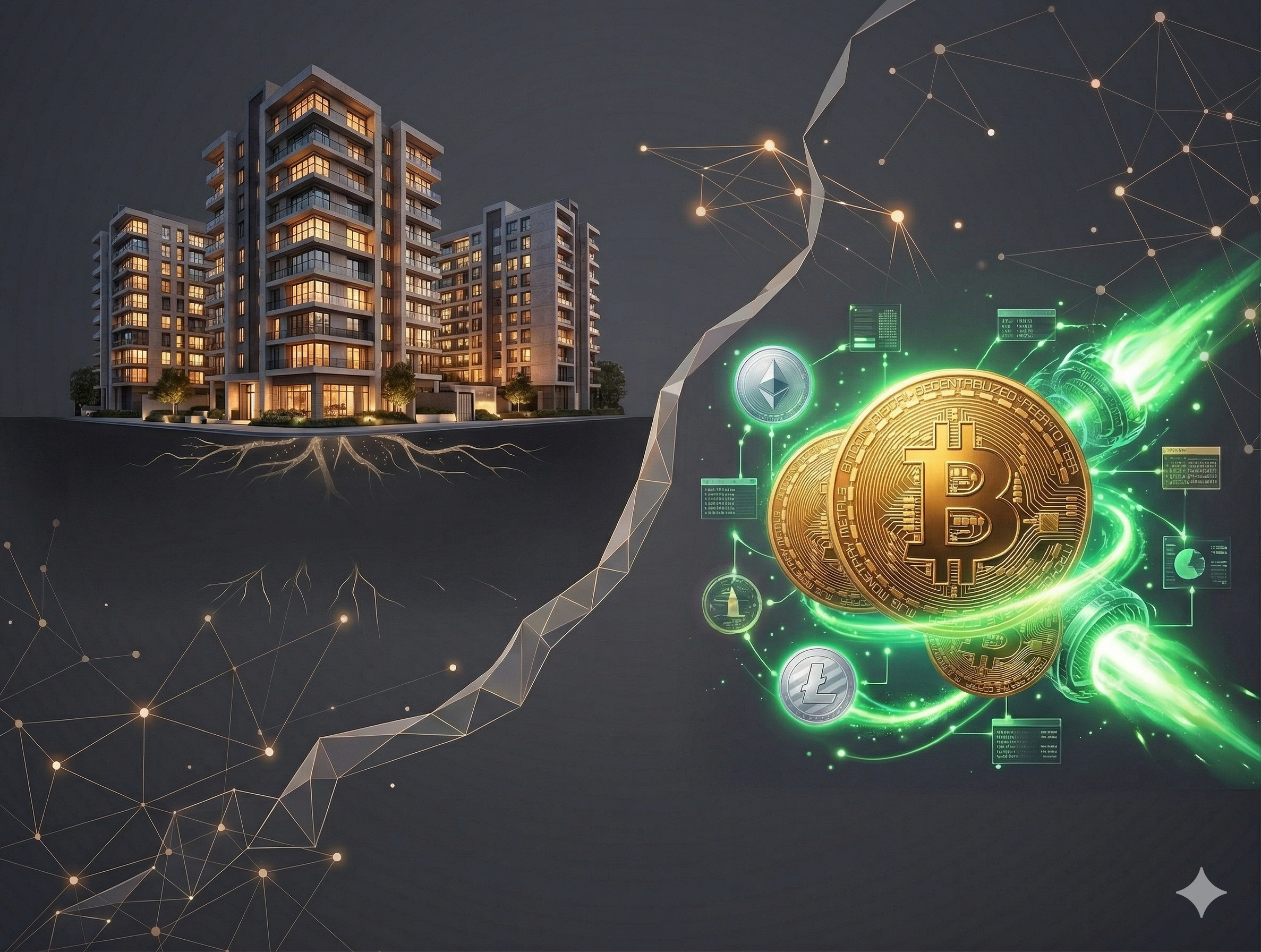
- Real Estate acts like the 'Roots,' providing a foundation for life and stabilizing your wealth.
- Bitcoin acts like the 'Engine,' accelerating wealth growth through high liquidity and growth potential.
In 2026, the wisest investor is likely the one who doesn't put all their eggs in one basket but instead strategically balances the stability of tangible assets with the efficiency of digital assets.
Note: This post reflects personal opinions and is not investment advice. All investment decisions are the responsibility of the individual.
'Investing & Finance' 카테고리의 다른 글
| 비트코인, 정말 신뢰할 수 있는 자산인가? 숫자가 증명하는 3가지 진실 (2) | 2026.04.13 |
|---|---|
| 초보를 위한 아파트 갈아타기 전략: 내 자산의 '뿌리'를 강화하는 법 (0) | 2026.04.10 |
| 자산 비교 분석: 비트코인 vs 부동산, 당신의 부를 지켜줄 진정한 승자는? (0) | 2026.04.09 |
| 2026 Bitcoin Price Outlook: Breaking New All-Time Highs or a Brutal Correction? (0) | 2026.04.08 |
| 2026년 비트코인 가격 전망: 전고점 탈환인가, 잔인한 조정장인가? (0) | 2026.04.08 |


