As Bitcoin transitions into a mainstream "institutional asset," its relationship with traditional financial markets has undergone a fascinating evolution. To understand Bitcoin's true nature, we must analyze its correlation with four key benchmarks: Gold, S&P 500, NASDAQ, and KOSDAQ.
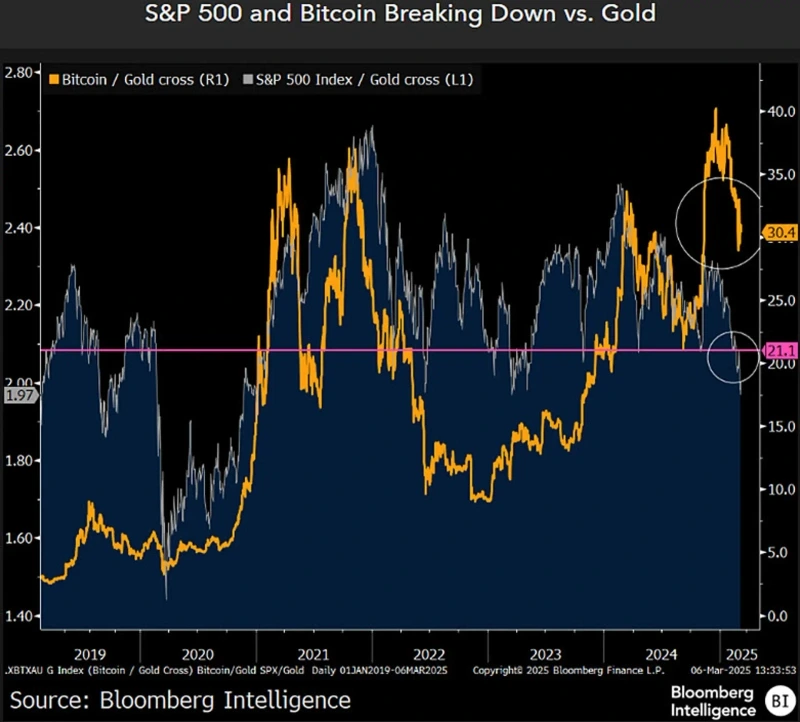
1. Bitcoin vs. NASDAQ & S&P 500: "The Risk-On Coupling"
The strongest correlation for Bitcoin remains with the US tech-heavy NASDAQ index.
- Asset Character: Both are classified as 'Risk-On Assets.' They tend to rally together when global liquidity is high and interest rates are low, and they retract simultaneously during monetary tightening.
- The Synchronized Trend: Data from 2024–2026 shows a positive correlation coefficient between Bitcoin and the S&P 500 ranging from 0.3 to 0.5. The correlation with the NASDAQ is often even higher, leading many analysts to describe Bitcoin as behaving like a "high-leverage tech stock."
2. Bitcoin vs. Gold: "The Distant Cousin of Digital Gold"
While Bitcoin is nicknamed "Digital Gold," its actual correlation with physical gold is surprisingly low, and sometimes even negative.
- Statistical Gap: Recent analyses show the correlation coefficient between Bitcoin and Gold hovering around 0.1 to 0.2. This indicates that the two assets move largely independently of each other.
- The Divergence: During sudden geopolitical crises, Gold often spikes immediately as a "safe haven," whereas Bitcoin might dip alongside tech stocks before recovering later.
- The Long-Term Synergy: Despite short-term differences, both assets share a long-term fundamental goal: acting as a hedge against inflation and central bank currency debasement.
3. Bitcoin vs. KOSDAQ: "The Barometer of Retail Sentiment"
The relationship between Bitcoin and South Korea’s KOSDAQ is defined more by 'Investor Psychology' than by technical fundamentals.
- Volatility Alignment: The KOSDAQ is heavily influenced by the NASDAQ and has a high percentage of retail (individual) investors, similar to the historical profile of Bitcoin.
- Liquidity Sensitivity: Both often rally when local liquidity in the Korean market is abundant. However, as Bitcoin becomes dominated by global institutional capital, its direct link to the KOSDAQ is gradually weakening compared to previous years.
[Summary Table: Bitcoin Correlation Comparison]
| Asset Class | Correlation Level | Summary |
| NASDAQ | High | Synchronized with Tech stocks and "Risk-On" sentiment |
| S&P 500 | Moderate | Shared influence of global economy and institutional liquidity |
| Gold | Low | Moves independently; shares long-term "Store of Value" traits |
| KOSDAQ | Moderate/Low | Influenced by retail sentiment and local liquidity |
Conclusion: Is Bitcoin Becoming a "Truly Independent" Asset Class?
The data suggests that Bitcoin currently behaves primarily as a high-growth risk asset, much like the NASDAQ. However, the most significant takeaway is that Bitcoin is increasingly showing a 'Low Correlation' to any single specific asset over the long term.
For investors, this means Bitcoin is evolving into a strategic diversification tool that can hedge portfolio risks when traditional stock markets falter. Rather than viewing Bitcoin as a gamble, it is time to recognize it as a unique commodity carving out its own distinct space in the global macro economy.
'Investing & Finance' 카테고리의 다른 글
| 양자컴퓨터 시대, 비트코인의 가치는 정말 증발할까? : 기술보다 중요한 '신뢰'의 향방 (0) | 2026.04.07 |
|---|---|
| 비트코인 vs 양자컴퓨터: 암호화 화폐의 성벽은 무너질 것인가? (0) | 2026.04.07 |
| 비트코인과 자산 시장: 금인가, 주식인가? 상관관계 완벽 분석 (0) | 2026.04.06 |
| Is the Bitcoin 4-Year Cycle Dead? From Supply Shock to Institutional Asset (0) | 2026.04.01 |
| 비트코인 4년 주기설은 이제 끝났는가? : 공급 절벽에서 제도권 자산으로 (0) | 2026.04.01 |


